Introduction
Selecting the wrong switchgear architecture can severely impact your facility's operational uptime and maintenance budget. A mismatched choice often leads to unnecessary project expenses or costly, unbudgeted factory downtime.
Whether you are designing a high-reliability industrial plant or a cost-sensitive commercial building, understanding unit flexibility is critical. This engineering guide breaks down the core differences between fixed type switchgear and withdrawable switchgear to help you make the right procurement decision.
What is Fixed Type Switchgear?
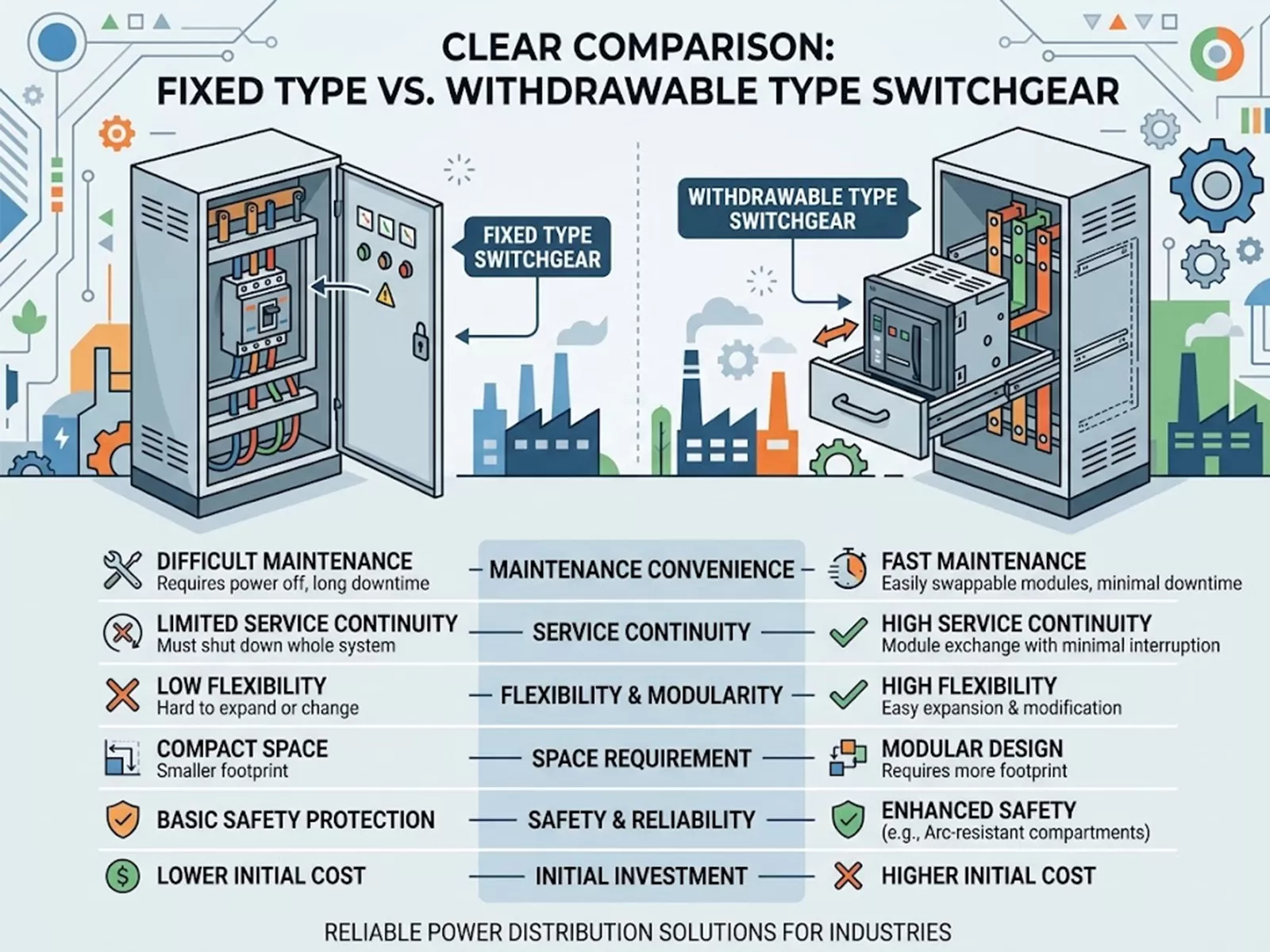
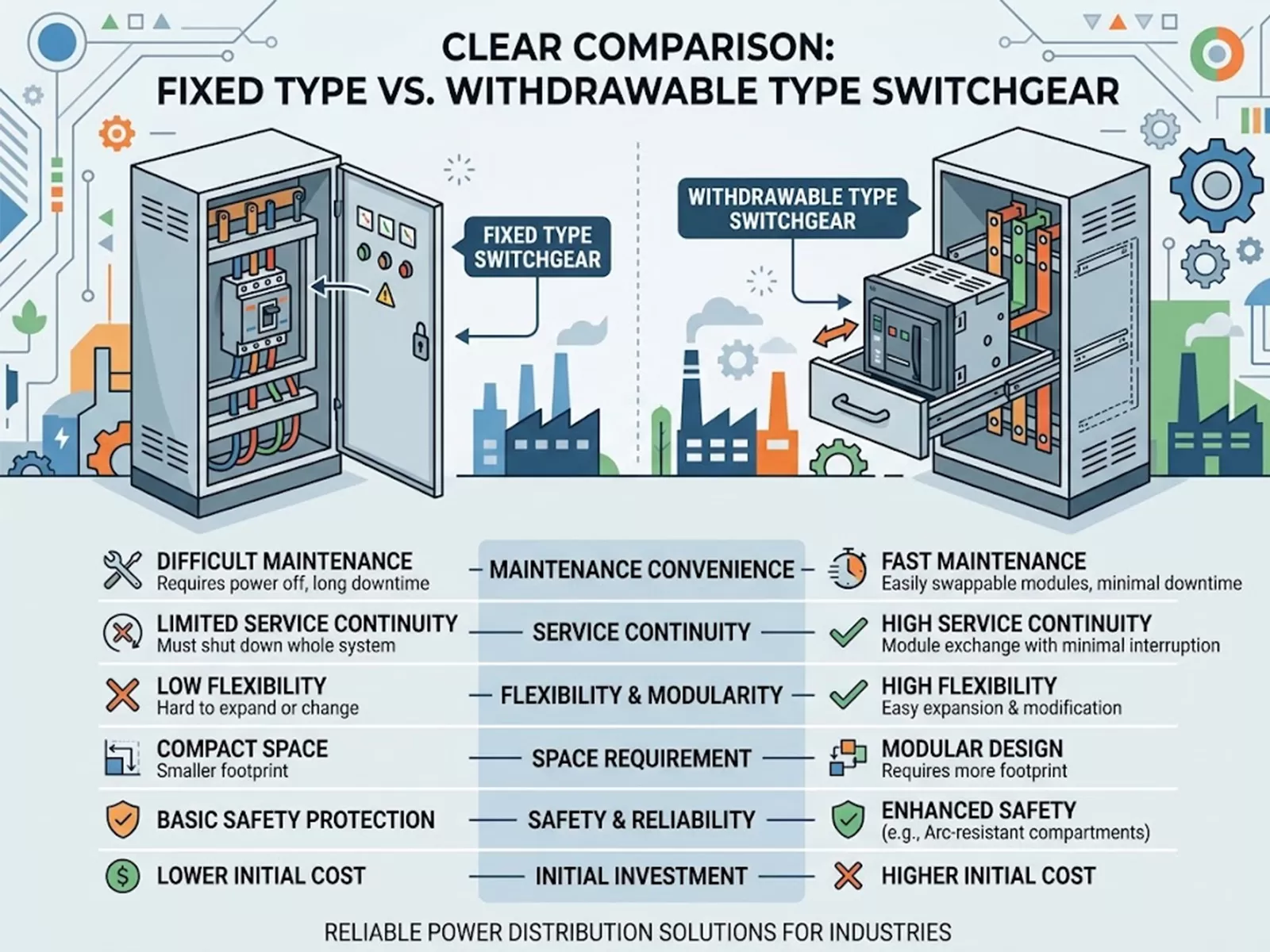
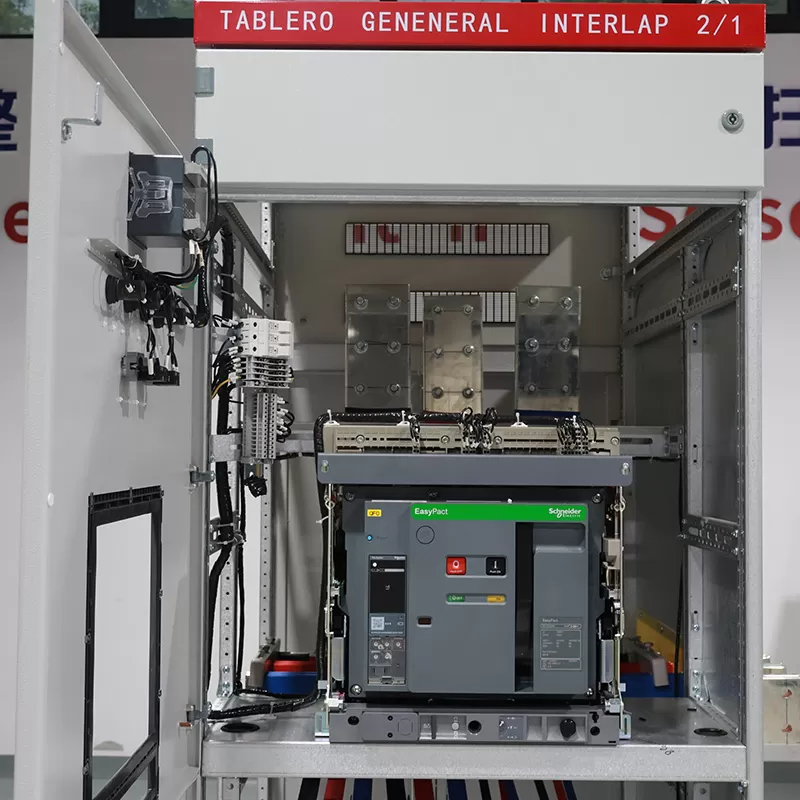
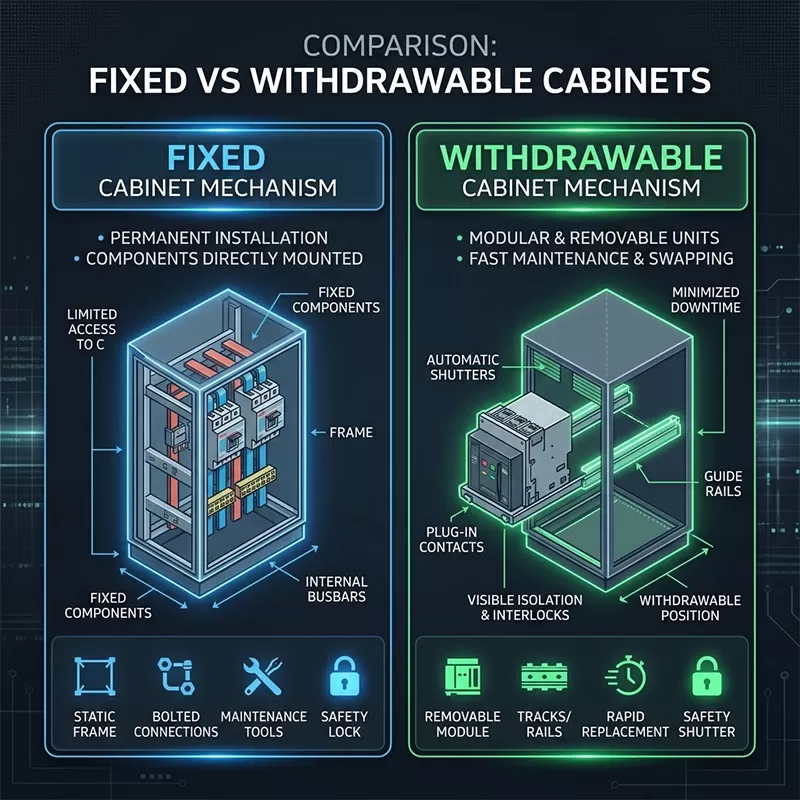
Fixed type switchgear features internal electrical components-such as breakers, switches, and busbars-bolted directly onto the enclosure frame. To service or replace any component, technicians must completely isolate and de-energize the entire panel section.
This design offers a straightforward, robust structure that has served as the backbone of standard industrial power distribution for decades. It is widely recognized for its simplicity and initial cost efficiency.
Key features of fixed installations include:
○ Components are permanently mounted and wired directly to the main busbar framework.
○ Lower initial manufacturing and equipment procurement costs.
○ Requires complete power shutdowns during routine electrical switchboard maintenance.
○ Simpler mechanical structure with fewer moving parts to wear out over time.
What is Withdrawable Switchgear?
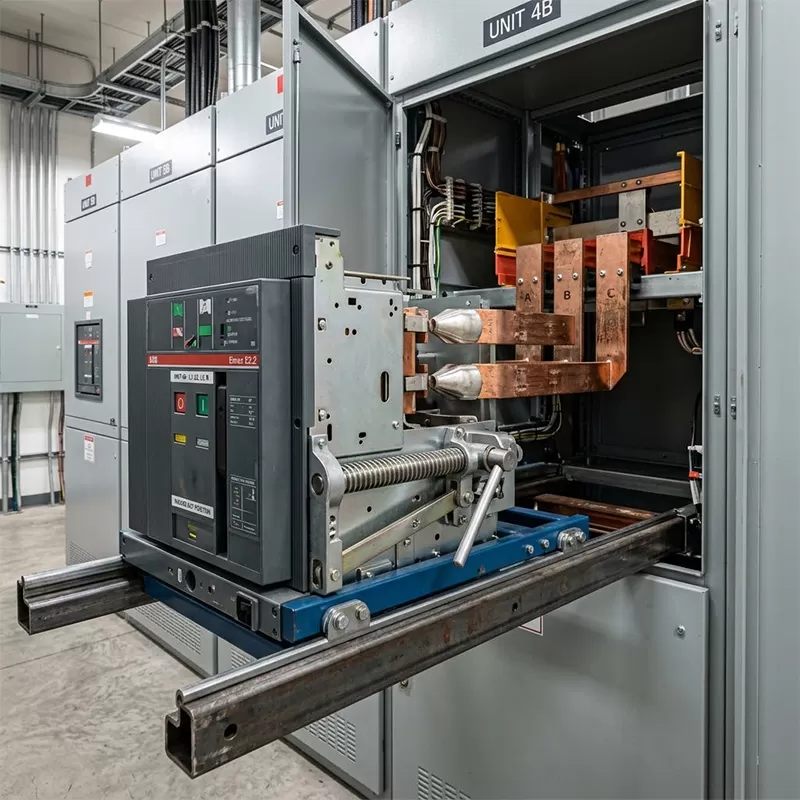
Withdrawable switchgear (also known as drawout switchgear) houses key functional units—especially the drawout circuit breaker—inside modular, cassette-style drawers. Technicians can easily rack these units out on guided rails without disconnecting main busbars or powering down adjacent operational cubicles.
This modular architecture is designed specifically for critical facilities where continuous power availability is mandatory. It acts as an upgrade over fixed designs by maximizing operational uptime and operator safety.
Key features of withdrawable installations include:
○ Modular drawer units equipped with self-aligning primary and secondary plug-in contacts.
○ Fast replacement of faulted breakers in minutes rather than hours.
○ Mechanically interlocked positions (Connected, Test, Disconnected) for enhanced maintenance safety.
○ Higher initial capital investment offset by significantly reduced facility downtime risks.
Core Differences Between Fixed and Withdrawable Switchgear
While both configurations deliver reliable power distribution, their operational characteristics differ significantly across key engineering metrics.
1. Maintenance & Downtime Impact
Fixed type switchgear requires a full panel shutdown to execute internal repairs, taking hours to isolate and unbolt components. Withdrawable switchgear allows technicians to rack out a faulty breaker and insert a spare module within minutes, maintaining continuous plant operation.
2. Operator Safety & Arc Flash Isolation
Fixed type switchgear exposes technicians to potential contact with live busbars if proper lock-out/tag-out procedures fail during maintenance. Withdrawable switchgear features automatic metallic safety shutters that close over live busbars when a functional unit is removed, preventing accidental contact.
3. Footprint & Space Utilization
Fixed type switchgear typically offers a compact footprint, allowing maximum breaker density in tight electrical rooms. Withdrawable switchgear requires deeper cabinet enclosures and clear frontal clearance to accommodate the physical racking movement of drawers.
4. Initial Investment vs. Total Cost of Ownership (TCO)
Fixed type switchgear delivers a significantly lower upfront purchase price, making it attractive for budget-constrained projects. Withdrawable switchgear carries a higher initial cost but yields a lower TCO over time in facilities where outage minutes incur heavy financial penalties.
5. Mechanical Complexity & Longevity
Fixed type switchgear relies on simple mechanical joints, requiring less periodic mechanical lubrication. Withdrawable switchgear incorporates complex racking mechanisms, position interlocks, and plug contacts that require periodic alignment checks.
Technical Specification Comparison
The following technical matrix outlines key operational parameters between both switchgear architectures.
Technical Capabilities Matrix
| Engineering Feature | Fixed Type Switchgear | Withdrawable Switchgear |
| Primary Circuit Connection | Hard-bolted cable/busbar joints | Self-aligning plug-in finger contacts |
| Typical Voltage Class | Low Voltage / Medium Voltage | Low voltage switchgear & MV applications |
| Mean Time to Repair (MTTR) | 2 to 6 Hours (Requires panel shutdown) | 10 to 15 Minutes (Hot-swappable module) |
| Internal Compartmentalization | Form 1 to Form 3b typical | Form 4a to Form 4b (Maximum isolation) |
| Interlocking Protection | Basic door padlocks & LOTO | Multi-stage mechanical position interlocks |
| Capital Cost Index | Baseline (100%) | ~135% - 150% of Baseline |
How to Choose the Right Solution for Your Facility?
Selecting between fixed and withdrawable designs depends primarily on your facility's tolerance for planned and unplanned electrical shutdowns.
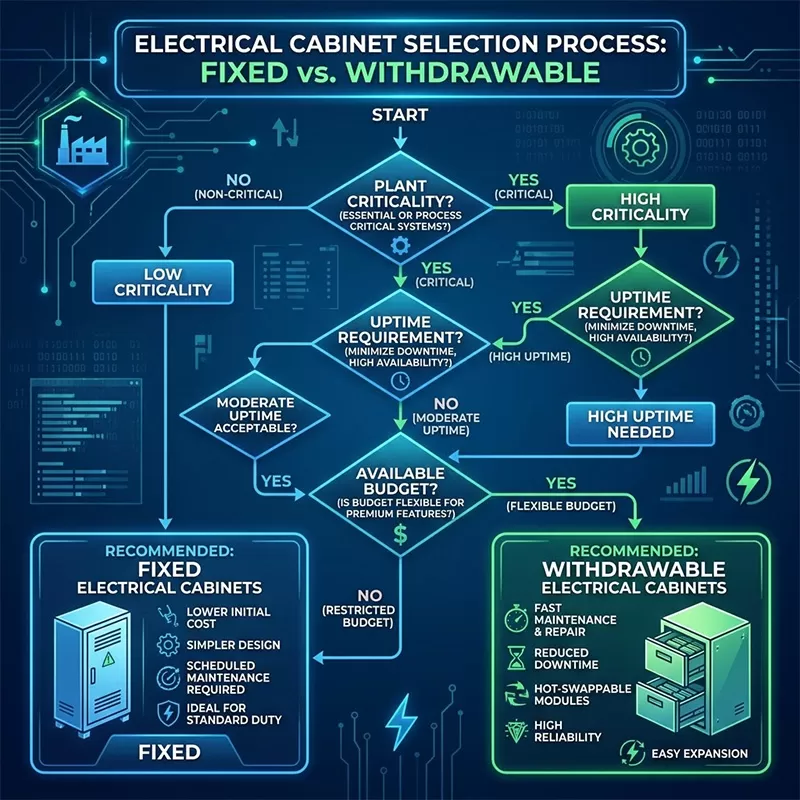
Scenario 1: Continuous Operations & Critical Infrastructure
Facilities such as data centers, oil refineries, hospital emergency grids, and continuous chemical processing plants cannot afford power interruptions.
○ Withdrawable switchgear is mandatory to ensure near-zero downtime during component maintenance.
○ Drawout modules allow immediate swapping of faulted feeder circuits without affecting adjacent live equipment.
○ Form 4 compartmentalization provides maximum arc flash protection for on-site engineering staff.
Scenario 2: Standard Commercial & Low-Maintenance Projects
Commercial office buildings, shopping malls, small residential complexes, and non-critical warehouses rarely require hot-swappable capability.
○ Fixed type switchgear provides a cost-effective, dependable power distribution cabinet solution.
○ Planned annual maintenance windows can easily accommodate necessary inspection shutdowns.
○ Lower initial capital expenditure frees up project budget for other MEP infrastructure needs.
Scenario 3: The Hybrid Approach for Complex Industrial Plants
Large manufacturing facilities often adopt a hybrid design strategy across their power distribution hierarchy.
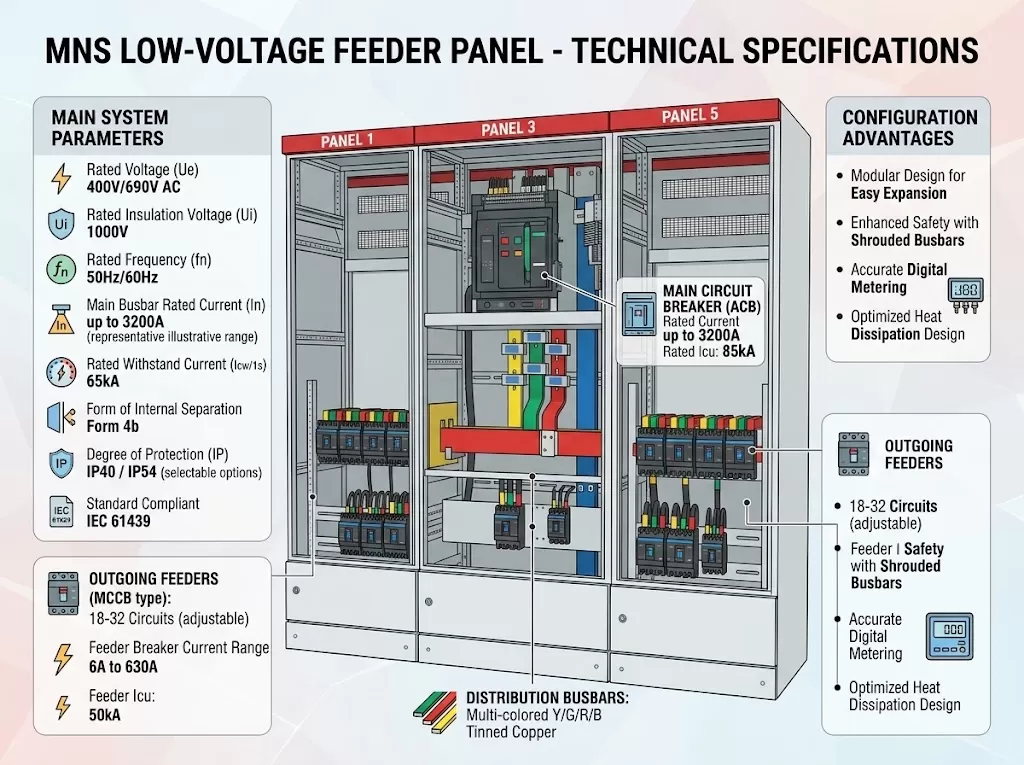
○ Main Incoming Feeders use withdrawable switchgear with ACB units for rapid recovery at the primary grid level.
○ Secondary Distribution Sub-panels utilize fixed type switchgear to optimize total equipment costs.
Project Application Matrix
Match your specific project profile against this engineering application matrix to select the ideal switchgear configuration.
| Application / Facility Type | Recommended Configuration | Primary Engineering Reason |
| Data Centers & Server Hubs | Withdrawable Switchgear | Requires 99.999% uptime; zero tolerance for maintenance shutdowns. |
| Commercial Office Towers | Fixed Type Switchgear | Cost-effective; maintenance can be scheduled during off-peak weekend hours. |
| Petrochemical Refineries | Withdrawable Switchgear | High hazard environment; requires Form 4 internal safety isolation. |
| Solar & Wind Farms | Fixed / Hybrid Switchgear | Optimized CAPEX for distributed outdoor inverter station enclosures. |
| Water Treatment Facilities | Hybrid Switchgear | Withdrawable for main pumps; fixed for secondary lighting & utility loads. |
FAQ
Q1: Can I convert an existing fixed cabinet into a withdrawable cabinet?
Retrofitting a fixed cabinet into a withdrawable unit is generally not cost-effective. Withdrawable designs require specialized internal racking rails, shutter mechanisms, and precise busbar contact alignment that standard fixed frames lack.
Q2: Do withdrawable plug-in contacts create higher electrical resistance over time?
High-quality silver- or tin-plated spring contacts prevent oxidation and maintain low resistance. Routine maintenance includes applying conductive grease and checking contact pressure during scheduled inspections.
Q3: Which option is better for harsh, high-vibration environments?
Fixed switchgear with bolted connections inherently resists mechanical vibration better. However, marine-rated withdrawable switchgear equipped with specialized locking latches is widely used on offshore platforms and ships.
Partner with XDEPE for Custom Power Solutions
Choosing between fixed and withdrawable switchgear comes down to balancing initial budget against long-term operational uptime requirements. Making the right choice early in the design stage prevents costly redesigns and ensures long-term grid stability.
At XDEPE, we engineer and manufacture custom-built low voltage switchgear tailored to your exact project single-line diagrams (SLD) and grid standards. Contact our technical engineering team today for expert consultation and factory-direct pricing on high-reliability power distribution solutions.