
Heavy manufacturing demands enormous electrical power. Industrial injection molders, CNC machining centers, stamping presses, and automated assembly conveyors draw high currents and run continuously. At the center of this power infrastructure sits your electrical distribution system.
An industrial 3 phase panel board does more than distribute incoming electricity. It balances severe dynamic loads, shields sensitive microelectronics from inductive kickbacks, and protects human operators from catastrophic arc events. Selecting the wrong assembly leads to premature thermal tripping, fried drive systems, code violations, and costly facility shutdowns.
Whether you are outfitting a brand-new production line or replacing an overloaded distribution point, this guide walks you through the technical steps required to specify a dependable heavy machinery electrical panel for your facility.
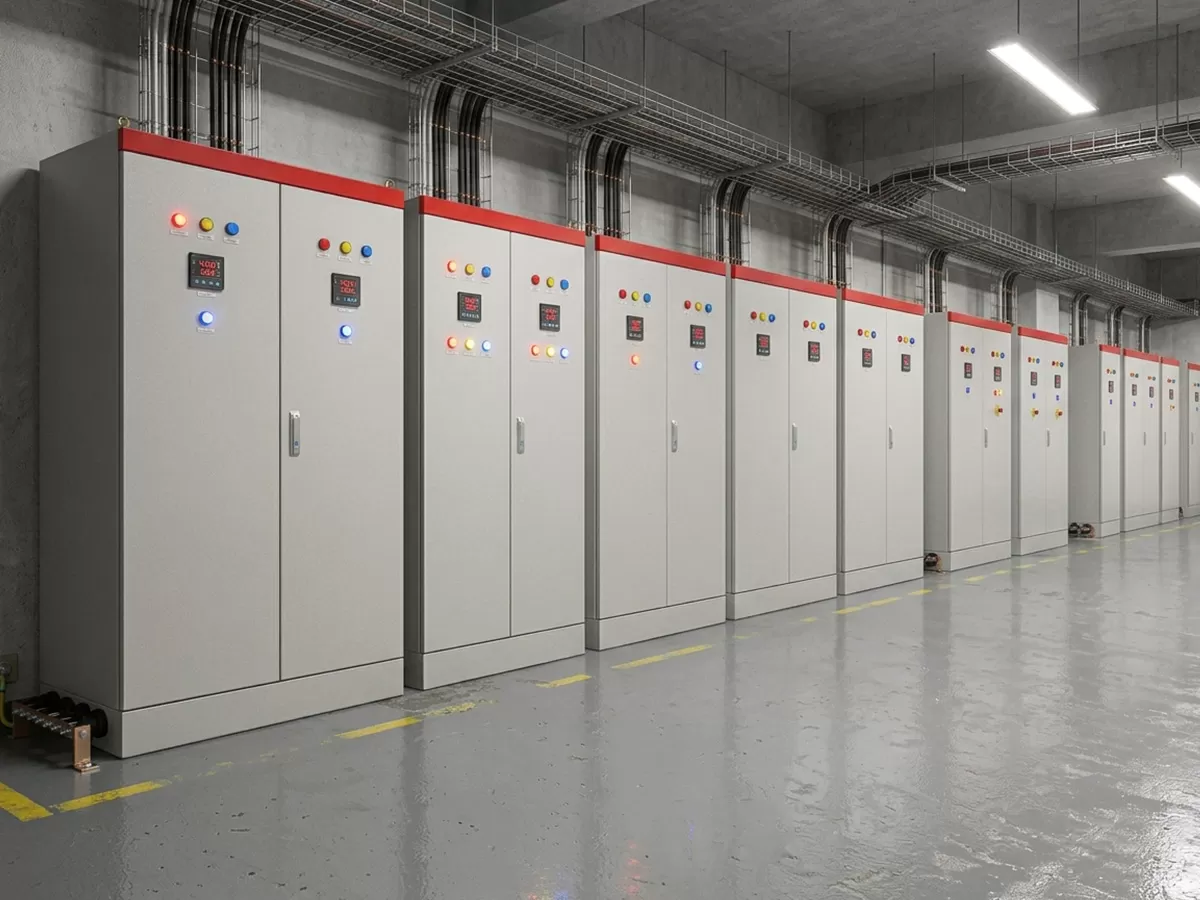
.webp?t=1793085286174 "3 phase panel board")
1. Assessing Electrical Load and Sizing the Main Busbar
Every equipment specification starts with accurate load accounting. Undersizing leads to nuisance breaker trips and insulation failure. Oversizing wastes significant capital budget.
Continuous vs. Non-Continuous Loads
Electrical codes draw a hard line between continuous and non-continuous operations. Under standard electrical codes like the NFPA 70 (National Electrical Code), a continuous load runs at maximum current for three hours or longer.
When sizing the mains for your 3 phase panel board for manufacturing, apply the 125% rule:
Total Design Amperage = (Sum of Non-Continuous Loads) + (125% of Continuous Loads) + (125% of Largest Motor Full Load Amps)
Large motors demand heavy inrush currents during startup—often six to eight times their running load amps (RLA). Your main busbar and branch protection must handle these transient spikes without tripping.
Matching Voltage, Phases, and Service Configurations
Ensure the incoming utility service aligns with machinery ratings. Common industrial three-phase configurations include:
- 480Y/277V (4-wire, Wye): Standard for heavy North American industrial facilities, driving motors at 480V line-to-line and lighting at 277V line-to-neutral.
- 208Y/120V (4-wire, Wye): Typical for light manufacturing, toolrooms, and secondary control systems.
- 400V/230V (4-wire, Wye, 50Hz): The dominant international standard across European and Asian production plants.
- 480V Delta (3-wire): Often used for heavy ungrounded motor loads, though lacking a direct neutral for control circuits.
Main Busbar Sizing and Material: Copper vs. Aluminum
Busbars form the physical spine of any 3 phase panel board. Main ratings in industrial settings generally range from 400A to 1200A, scaling beyond 2000A for heavy power distribution centers.
Specify copper busbars for harsh industrial floors. While aluminum offers a lower initial purchase price, copper provides superior electrical conductivity, higher mechanical strength against short-circuit forces, and far lower thermal expansion. In environments with heavy vibration or cyclic thermal loading, copper connections stay tight and resist oxidation far better than aluminum.
2. SCCR, Interrupting Capacity, and Circuit Protection
System voltage and amperage calculations are only the baseline. You must also determine how much destructive short-circuit energy the panel can safely withstand.
Why SCCR Matters
The Short-Circuit Current Rating (SCCR) denotes the maximum fault current a panel can safely endure without exploding, vaporizing conductors, or starting a fire. If your utility transformer can deliver 45,000 Amperes of Available Fault Current (AFC), installing a 3 phase panel board rated for only 10,000 SCCR creates a direct safety hazard and violates workplace safety mandates.
Calculate the available fault current at the panel terminals. Always specify an assembly where the overall SCCR meets or exceeds that calculated fault level.
Branch Breakers: MCCB vs. MCB
Not all circuit breakers suit industrial machinery loads:
- Miniature Circuit Breakers (MCB): Best suited for low-current control circuits, secondary panels, and non-inductive loads (generally up to 63A or 100A with modest interrupting capacities).
- Molded Case Circuit Breakers (MCCB): The standard for heavy manufacturing loads. MCCBs handle ratings up to 2500A, feature high interrupting ratings (often 35kA to 100kA+), and offer adjustable trip thresholds (long-time, short-time, instantaneous, and ground-fault protection).
For heavy duty cycles, choose electronic trip units or thermal-magnetic MCCBs that allow engineers to calibrate trip curves directly to motor starting profiles.
Surge Protection Device (SPD) Integration
Modern production machines rely on sensitive programmable logic controllers (PLCs), variable frequency drives (VFDs), and servo controllers. Inductive surges caused by switching large inductive loads or nearby lightning strikes can destroy these solid-state devices. Industrial manufacturers like XDEPE integrate dedicated Type 1 or Type 2 Surge Protective Devices directly into their panel assemblies to clamp voltage transients at the primary distribution stage.
3. Enclosure Protection: Choosing the Right NEMA or IP Rating
Factory environments challenge electrical equipment with dust, metal shavings, cutting fluids, and temperature extremes. Housing your distribution gear in an inadequate box guarantees downtime.
Common Industrial Enclosure Standards
Industrial enclosures are classified using either NEMA (National Electrical Manufacturers Association) or IP (Ingress Protection) systems:
- NEMA 1 / IP20: General-purpose indoor protection. Suitable only for dedicated, clean, climate-controlled electrical closets.
- NEMA 12 / IP54: Standard indoor industrial protection. Protects against circulating dust, falling dirt, lint, fibers, and non-corrosive dripping liquids or coolant splashing. This is the minimum baseline for standard machine shop floors.
- NEMA 4 / IP66: Watertight and dust-tight. Designed for indoor or outdoor areas subject to direct high-pressure hose-downs.
- NEMA 4X: Delivers the same water and dust protection as NEMA 4, but is fabricated from 304 or 316 stainless steel to withstand corrosive agents, washdown chemicals, and salt spray.
Thermal Management Inside the Enclosure
A heavily loaded 3 phase distribution board generates significant internal heat. If you place the panel inside an unventilated NEMA 12 or NEMA 4 box next to a furnace or injection molding press, ambient internal temperatures can exceed component ratings.
Calculate heat dissipation early. Determine if your installation requires integrated louvers with replaceable dust filters, closed-loop thermoelectric coolers, or vortex cabinet coolers to maintain internal operating temperatures below 40°C (104°F).
4. Scalability, Modular Layouts, and Smart Monitoring
Manufacturing facilities constantly change. Product lines shift, old tools leave, and new high-output machines arrive. Sizing your electrical panel strictly for current machinery creates severe roadblocks later.
The 20% to 30% Spare Capacity Rule
Always specify a 3 phase panel board with 20% to 30% unassigned physical breaker spaces and equivalent busbar ampacity headroom. Retrofitting an undersized panel after commissioning costs far more than purchasing an extra frame size during initial construction.
Submetering and Smart Power Monitoring
Modern industrial power panels incorporate digital power meters and network communications. Integrating smart metering brings clear operational advantages:
- Monitors real-time phase balance, power factor, and harmonic distortion caused by VFDs.
- Tracks energy consumption per manufacturing cell or machine for accurate cost-of-goods accounting.
- Provides alarm notifications for phase loss or sustained overcurrent before a protective device trips.
Modern engineering platforms allow brands like XDEPE to deliver pre-wired communication options (such as Modbus TCP/RTU or Ethernet/IP) directly from main breakers to your plant Supervisory Control and Data Acquisition (SCADA) network.
5. Mandatory Safety Standards and Regulatory Compliance
A non-compliant panel can void facility insurance, trigger heavy OSHA fines, and shut down operations during a municipal safety inspection. Verify that your electrical panel matches regional and industry-specific certifications.
Key Regulatory Benchmarks
- UL 67 & UL 508A: In North America, panelboards must conform to the UL Standards for Safety. UL 67 governs distribution panelboards, while UL 508A dictates the design of industrial control panels.
- IEC 61439-1 / IEC 61439-2: The globally recognized design standard developed by the International Electrotechnical Commission. This standard applies to low-voltage switchgear and controlgear assemblies, outlining type-tested verification of temperature rise, dielectric properties, and short-circuit withstand strength.
- NFPA 70E: Guides electrical safety requirements in the workplace. Panels designed with dead-front construction, finger-safe component covers, and clear arc-flash safety labeling minimize hazards for maintenance personnel during diagnostics.
Always demand third-party test certifications and documented compliance reports from your panel supplier before approving manufacturing submittals.
6. Industrial 3 Phase Panel Board Selection Checklist
Use this practical checklist when drafting your equipment specifications or requesting vendor quotes:
- Voltage & Configuration: [ ] 480Y/277V [ ] 208Y/120V [ ] 400V/230V [ ] Delta (50Hz / 60Hz)
- Main Current Capacity: Calculated peak running amps + 125% continuous loads + expansion margin.
- Busbar Specification: Tin-plated or bare copper rated for target ambient operating temperature.
- Short-Circuit Withstand (SCCR): Calculated available utility fault current matched (e.g., 22kA, 42kA, 65kA, 100kA).
- Branch Protective Devices: Fixed or adjustable MCCBs equipped with required trip characteristics.
- Environmental Enclosure: NEMA 12 (machining floor), NEMA 4X (chemical/washdown), or NEMA 1 (clean electrical room).
- Future Expansion: Minimum 20% usable spare breaker positions and spare busbar capacity.
- Surge Suppression: Type 1 or Type 2 integrated SPD with operational status dry contacts.
- Safety Certifications: UL 67, UL 508A, or IEC 61439 compliance documentation.
Frequently Asked Questions (FAQ)
Q1: How do I calculate the proper main breaker size for a 3 phase
panel board running mixed industrial loads?
A1: Add
100% of the non-continuous equipment amperage to 125% of the continuous
operating loads (equipment running for three continuous hours or more). Add 125%
of the full-load amperage of the largest motor in the group. Select the next
standard breaker size above this final calculated total to prevent false trips
during sustained production runs.
Q2: Why should I choose copper busbars over aluminum for
manufacturing facilities?
A2: While aluminum costs
less initially, copper delivers higher electrical conductivity and superior
tensile strength. Heavy factory equipment creates vibration and thermal cycles.
Copper experiences less thermal expansion and contraction, preventing loose
terminal connections, hot spots, and oxidation failures over long operating
lifespans.
Q3: What happens if the SCCR rating on my 3 phase panel board is
lower than the available fault current?
A3: If a
catastrophic short circuit occurs, an undersized panel cannot contain the
magnetic and thermal forces. The internal busbars can warp, circuit breakers can
explode, and sustained arc flashes can destroy surrounding equipment or injure
personnel. Furthermore, operating panels with insufficient SCCR violates NEC
Article 409 and OSHA safety standards.
Q4: How should neutral conductors be sized for modern heavy
manufacturing panels?
A4: When non-linear loads
like variable frequency drives, switching power supplies, and automated welding
lines dominate your floor, they generate high third-order harmonic currents.
These triplen harmonics accumulate directly on the neutral conductor rather than
canceling out. In heavy non-linear environments, specify a 200% rated, oversized
neutral bus to prevent dangerous overheating.
Q5: Can I convert a standard indoor NEMA 1 panel for use on a dusty
manufacturing floor?
A5: No. Standard NEMA 1
enclosures have open venting louvers and unsealed seams designed solely for
clean, dry locations. Adding filters or tape to a NEMA 1 enclosure violates
safety listings and fails to stop fine conductive metal dust or splashing
coolants from causing phase-to-phase shorts. Always install a factory-certified
NEMA 12, NEMA 4, or NEMA 4X enclosure.
Investing in Long-Term Plant Productivity
Choosing an industrial 3 phase panel board is an operational investment that dictates plant safety, uptime, and growth potential. Cutting corners on busbar sizing, enclosure ratings, or short-circuit withstand capabilities creates severe production risks down the road.
Work with an experienced engineering partner who understands the mechanical and electrical realities of modern heavy industry. XDEPE designs and fabricates high-performance industrial power panels built for demanding operational environments.
Ready to upgrade your manufacturing infrastructure? Submit your electrical single-line diagram (SLD) or equipment specifications to the technical team at XDEPE today for a tailored engineering assessment, compliance validation, and a rapid commercial quotation.




 Cabinet (1).webp "Automatic Transfer Switch (ATS) Failure: 5 Common Causes and How to Fix Them")
.webp "How to Select the Right 3 Phase Panel Board for Heavy Manufacturing Equipment")
 Switchgear (1).webp "What is a Withdrawable (Drawer-Type) Switchgear? A Complete Beginner's Guide")
.webp "Main Distribution Board vs. Sub Main Distribution Board: What's the Difference & How to Choose?")
