
Exporting heavy machinery to international markets involves rigorous technical hurdles. Machine builders shipping equipment to the European Union, the Middle East, or Australia frequently encounter sudden customs holdups. In many cases, the issue traces back to non-compliant electrical panels and power hardware.
A machine's electrical feed forms its operational core. If your 3 phase distribution box fails to meet recognized international safety norms, overseas authorities can reject the entire machine tool, packaging line, or automated system. Re-engineering a control cabinet on an overseas dock generates crippling costs.
Engineering teams often assume standard industrial components guarantee overall compliance. That assumption is dangerous. At XDEPE, we design industrial power distribution units specifically to withstand cross-border regulatory scrutiny and hostile site environments.
Need to audit your export machinery before shipping? Contact the electrical engineering team at XDEPE for a comprehensive design review and quotation on compliant electrical panels.
What is the IEC 61439 Standard, and Why Does It Matter for Export Machinery?
The International Electrotechnical Commission introduced the IEC 61439 series to govern low-voltage switchgear and controlgear assemblies. It directly replaces the older, ambiguous IEC 60439 standard. IEC 61439 consists of several distinct sections, but two hold critical importance for export machinery:
- IEC 61439-1: General rules covering definitions, service conditions, construction requirements, and technical verification.
- IEC 61439-2: Power switchgear and controlgear assemblies (PSC-assemblies), which applies directly to industrial distribution panels.
Compliance with this standard carries direct legal weight. In Europe, meeting IEC 61439 satisfies the safety targets of both the Low Voltage Directive (LVD 2014/35/EU) and key sections of the Machinery Directive (2006/42/EC). Without verified documentation matching these rules, your CE Declaration of Conformity remains legally vulnerable.
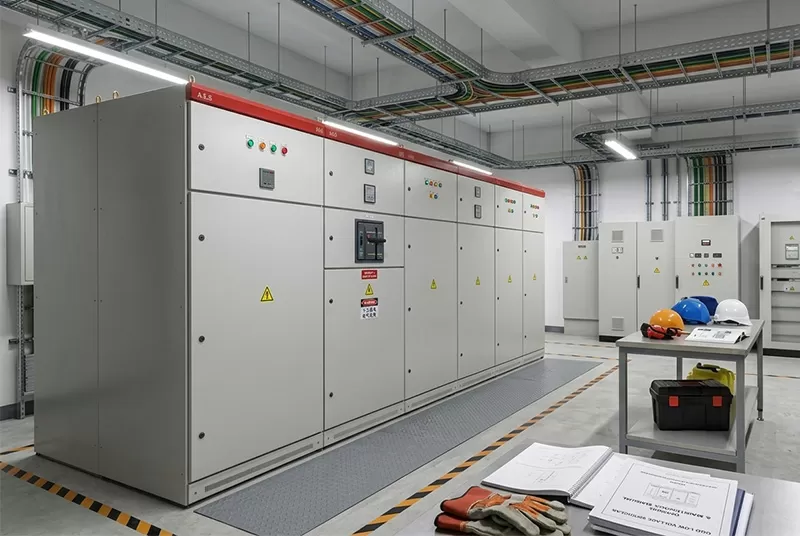
A heavy-duty 3 phase distribution box acts as the primary gatekeeper for raw energy inside an automated production unit. It splits high-amperage, three-phase grid power into discrete sub-circuits that drive servos, pumps, heating elements, and programmable logic controllers. If that junction fails, personnel face severe arc flashes, and equipment suffers complete destruction.
5 Critical Verification Requirements Under IEC 61439
IEC 61439 eliminated the confusing division between type-tested (TTA) and partially type-tested (PTTA) boards. The standard now requires design verification through three distinct methods: testing, calculation, or adherence to strict design rules. Inspecting your power cabinet requires evaluating five main safety pillars.
1. Temperature Rise Limits
Electrical current creates heat. Pack multiple circuit breakers, busbars, and terminal blocks inside a sealed enclosure, and heat builds rapidly. IEC 61439 dictates strict upper operating limits for internal air, terminals, and accessible metal surfaces.
Uncontrolled internal heat degrades wire insulation and causes false breaker tripping. A properly engineered 3 phase distribution box factors in total power loss, busbar cross-sectional dimensions, internal component spacing, and forced or natural convection cooling pathways.
2. Dielectric Properties and Clearances
Three-phase systems deal with substantial potential differences between live phases, neutral, and earth. High-voltage spikes caused by switching inductive loads or nearby lightning strikes can bridge air gaps.
The standard establishes clear rules for:
- Clearance: The shortest physical distance through air between two conductive parts.
- Creepage distance: The shortest distance along the surface of a solid insulating material.
If your panel builders cram high-amperage conductors together without maintaining specified distances for the designated insulation voltage (Ui), dielectric breakdown occurs. This triggers violent phase-to-phase short circuits.
3. Short-Circuit Withstand Strength
When a downstream mechanical fault creates a dead short, available fault current surges within milliseconds. This sudden rush generates violent electrodynamic forces capable of bending solid copper busbars, snapping support brackets, and throwing internal shrapnel.
Under IEC 61439, manufacturers must verify that a 3 phase distribution box can endure its rated short-time withstand current (Icw) or rated conditional short-circuit current (Icc). Protective devices must clear the fault before physical deformation compromises internal insulation barriers.
4. Enclosure Ingress Protection (IP Rating) and Mechanical Impact (IK Code)
Industrial machinery exports rarely live in clean rooms. Processing lines create dust, coolant spray, water vapor, and mechanical vibrations. IEC 61439 requires verification of external housing integrity.
Enclosures must provide verified ingress protection ratings—typically IP54, IP55, or IP65 for harsh washdown areas. Furthermore, enclosures need a rated IK impact code to confirm that shop-floor collisions will not deform the metalwork and push conductive elements against grounded structural frames.
5. Effectiveness of the Protective Circuit (Earth Continuity)
Grounding protects human life. The standard mandates low-resistance continuity across all exposed conductive parts of the assembly. Whether checking door hinges, painted side panels, or removable mounting plates, grounding paths must handle fault currents safely.
If an internal line conductor shakes loose and contacts the cabinet body, the protective circuit must channel that fault directly to earth. This instantly trips the upstream circuit breaker and shields machine operators from lethal shock hazards.
The Hidden Costs of Exporting Non-Compliant Distribution Assemblies
Skimping on electrical hardware certification creates heavy downstream risks. Equipment manufacturers often try to maximize profit margins by sourcing generic local enclosures. That approach frequently backfires once the machinery crosses international borders.
Consider the practical consequences of shipping an uncertified power hub:
- Port Rejections and Customs Seizures: Market surveillance agencies across the EU and the UK actively inspect industrial imports. Missing test documentation can trap a multi-million-dollar machine on a shipping dock for months, triggering thousands in daily demurrage fees.
- Disastrous Site Fires: A low-tier 3 phase distribution box lacking documented temperature-rise validation can overheat under continuous full-load production, igniting adjacent control wiring and destroying the client facility.
- Voided Product Liability Insurance: When an industrial accident occurs, commercial insurance investigators check technical compliance files first. If internal panels deviate from international standards, underwriters frequently deny claims, leaving the machinery OEM directly liable.
OEM Self-Inspection: How to Verify Compliance Before Shipping
Protect your brand reputation by establishing an internal audit routine for every custom machine before factory acceptance testing (FAT). Never assume a panel is compliant simply because the internal relays carry international marks.
OEM engineering departments should follow three baseline verification protocols:
1. Differentiate Design Verification from Routine
Verification
Design verification proves the fundamental engineering
concept through testing or calculations. Routine verification happens on every
single unit before dispatch. Your production crew must conduct dielectric tests,
verify terminal torque specs, check mechanical interlocks, and confirm earth
bonding on each manufactured panel.
2. Audit All Core Component Certifications
Open the door
and inspect the hardware. Ensure that primary molded case circuit breakers
(MCCB), miniature circuit breakers (MCB), contactors, and disconnect switches
hold independent IEC or UL marks. Unbranded or counterfeit safety devices
automatically nullify system compliance.
3. Review the Technical Construction File (TCF)
Assemble
your regulatory paperwork before shipping the machine. Regulators expect to see
a comprehensive wiring schematic, complete terminal layouts, short-circuit
withstand calculations, temperature rise assessments, and a clear manufacturer
nameplate on the outside of the enclosure.
Modern electrical assemblies built by XDEPE feature clearly marked technical ratings, documented test records, and robust mechanical structures designed directly for straightforward international trade clearance.

Selecting an IEC 61439 Compliant Partner for Custom Assemblies
Machine tool builders excel at mechanical design, hydraulic dynamics, and automation software. However, building low-voltage power panels requires specialized electrical manufacturing competencies.
When selecting a manufacturing partner for your industrial 3 phase distribution box, evaluate their testing pedigree. Do they back their busbar systems with accredited third-party test records from bodies like TÜV, SGS, or DEKRA? Can their engineers tailor internal panel architecture to reconcile different regional incoming grids, such as 400V 50Hz systems in Europe versus 480V 60Hz networks in North America?
A dependable power partner reviews your overall system layout, identifies potential thermal choke points, and builds custom configurations that slip through customs checks cleanly, regardless of destination.
Frequently Asked Questions
Q1: What is the main difference between an ordinary breaker box and
an IEC 61439 compliant 3 phase distribution box?
A1: An ordinary
breaker box is simply an unverified container holding separate electrical parts.
An IEC 61439 compliant assembly is an engineered, comprehensively tested system.
It has documented proof that the housing, busbars, wiring, and protective
switchgear safely handle thermal limits, short-circuit explosions, and
dielectric stresses together as a unified system.
Q2: Can I use UL-listed components to satisfy IEC 61439 requirements
for European export?
A2: Not automatically. While UL standards match
or exceed IEC standards in certain areas, the testing criteria and calculation
methods differ. Many high-tier electrical brands manufacture dual-rated
components (UL and IEC). Always confirm that components match the specific IEC
reference numbers listed within IEC 61439-1 and 61439-2.
Q3: Does every custom 3 phase distribution box need physical
laboratory destruction tests?
A3: No. IEC 61439 provides structured
pathways for design verification. While physical type-testing in a lab remains
the gold standard, the standard allows rigorous engineering calculations and
derived design rules for specific parameters, provided these rules reference
previously verified baseline designs.
Q4: Why does temperature rise testing matter so much for industrial
machinery enclosures?
A4: Export machinery enclosures often run
continuously under heavy electrical loads within warm factory environments.
Excessive heat degrades wire insulation, lowers the tripping threshold of
thermal-magnetic breakers, and can cause unexpected system shutdowns. Verifying
thermal thresholds ensures the panel operates safely at rated current without
catching fire.
Q5: What marking information must appear on the exterior nameplate of
an export distribution box?
A5: Under IEC 61439, the assembly
nameplate must clearly identify the original manufacturer, the specific assembly
designation, the relevant standard (e.g., IEC 61439-2), current rating (InA),
rated operational voltage (Ue), short-circuit withstand rating, and the
enclosure IP rating.
Secure Your Export Compliance Today
Cross-border technical regulations should never disrupt your international machinery sales. Compliance is not an administrative burden; it is an active market advantage that protects your revenue and your end users.
Are you updating an existing equipment line, or designing a new machine for international delivery? XDEPE engineers and manufactures fully certified industrial power assemblies built to survive challenging operating conditions.
Contact XDEPE today to review your electrical prints, discuss custom configurations, and receive a competitive quote on an IEC-compliant 3 phase distribution box built to pass customs inspection on arrival.




 Cabinet (1).webp "Automatic Transfer Switch (ATS) Failure: 5 Common Causes and How to Fix Them")
.webp "How to Select the Right 3 Phase Panel Board for Heavy Manufacturing Equipment")
 Switchgear (1).webp "What is a Withdrawable (Drawer-Type) Switchgear? A Complete Beginner's Guide")
.webp "Main Distribution Board vs. Sub Main Distribution Board: What's the Difference & How to Choose?")
