
Introduction
Electricity powers the modern industrial landscape. However, controlling and distributing it safely requires highly specialized equipment.
When high voltage power is stepped down at a transformer, it cannot be used immediately. It must be divided, monitored, and protected. This happens long before reaching loads like heavy motors or lighting arrays.
This critical transition point is exactly where the low voltage switchgear comes into play.
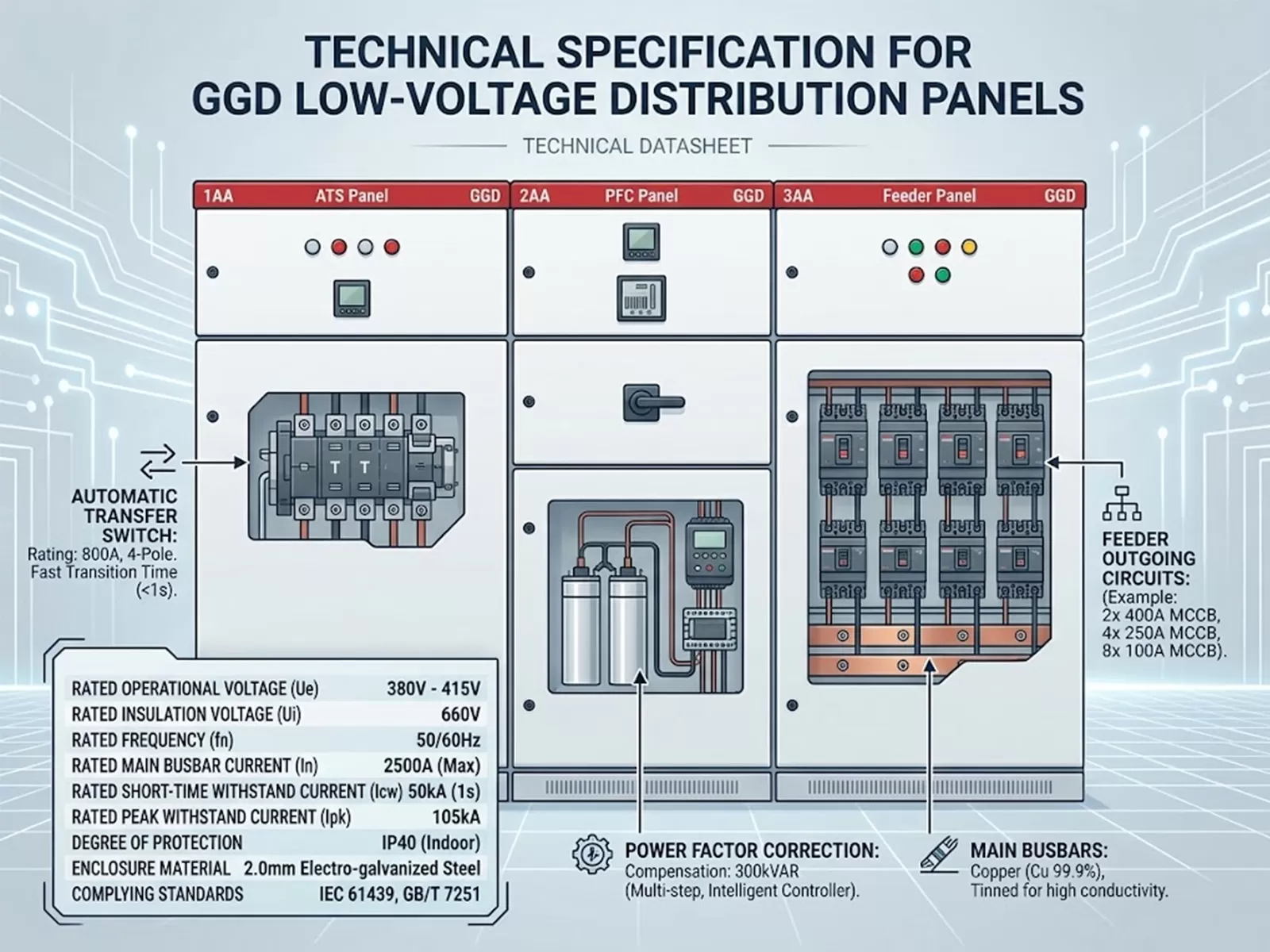
What is Low Voltage Switchgear? Definition and Purpose
In a single sentence: It is a centralized collection of electrical components housed in a metal enclosure.
According to international standards like IEC 61439, "low voltage" refers to systems operating up to 1,000V AC or 1,500V DC. Therefore, this equipment serves as the primary electrical distribution point for industrial facilities within these parameters.
It serves three distinct and highly critical functions:
● Electrical Protection: It detects abnormal conditions like short circuits and instantly interrupts the power flow.
● Power Isolation: It provides mechanical switches to disconnect specific circuits, ensuring a safe environment for maintenance personnel.
● Power Distribution: It takes a massive incoming current (up to 6300A) and splits it into smaller, manageable outgoing feeder circuits.
Standard Electrical Parameters
| Parameter | Standard Specification | Notes |
| Rated Operational Voltage | 400V, 415V, 480V, 690V AC | Varies by region and specific application. |
| Rated Current (In) | Up to 6300A | Determines the capacity of the main busbar. |
| Rated Frequency | 50Hz / 60Hz | Dependent on the national power grid standards. |
| Short-Circuit Withstand | 50kA, 65kA, 80kA, 100kA (1s) | Maximum fault current the cabinet can endure. |
| IP Rating | IP31, IP42, IP54, IP65 | Dictates resistance to dust and water ingress. |
How Does Low Voltage Switchgear Work?
Understanding the LV switchgear working principle requires tracing the electrical path. We must observe how the logic reacts to normal conditions versus severe faults.
Here is the step-by-step operational workflow:
● Power Entry: Electrical power enters from the distribution transformer directly into the main incoming circuit breaker.
● Main Busbar Routing: Current flows into the primary conductive backbone, which runs horizontally across the entire assembly.
● Vertical Distribution: Vertical copper bars drop down to feed individual outgoing circuit breakers.
● Normal Delivery: Electricity flows safely out to a localized low voltage distribution board or directly to machinery.
● Fault Detection: If a short circuit occurs, intelligent sensors (CTs) instantly detect the massive current spike.
● Arc Extinction: The breaker trips in milliseconds, pulling contacts apart and forcing the electrical arc into a chute to cool and extinguish it.
.webp?t=1786434578205 "What Is Low Voltage Switchgear (2)")
Key Components of Low Voltage Switchgear
A robust electrical panel is an engineered assembly of precision parts.
To fully grasp the architecture, we must examine the specific low voltage switchgear components inside the enclosure.
.webp?t=1786434578205 "What Is Low Voltage Switchgear (3)")
● Circuit Breakers
The circuit breaker is the active heart of the system. They manually switch circuits and automatically clear dangerous faults.
● Busbar System
Busbars are thick, rigid strips of highly conductive copper or aluminum. They carry the massive main electrical load. A dedicated ground busbar also runs along the bottom to protect operators from electric shock.
● Instrument Transformers (CTs and VTs)
Protection relays cannot withstand thousands of amps. Current Transformers (CTs) reduce high current to a standard 5A signal. Voltage Transformers (VTs) step down the voltage to a safe 110V for digital meters.
● Protection Relays
These microprocessors act as the brain of the system. They monitor the data from the transformers. If they detect an anomaly, they instantly trigger the mechanical breaker.
● Enclosures and Compartments
The outer shell is constructed from heavy-gauge, corrosion-resistant steel. Internally, metal barriers segregate different components. This localizes arc flash damage and protects maintenance personnel.
.webp?t=1786434578205 "What Is Low Voltage Switchgear (4)")
ACB vs. MCCB Comparison
| Feature | Air Circuit Breaker (ACB) | Molded Case Circuit Breaker (MCCB) |
| Typical Location | Main incoming power feed | Outgoing feeder circuits |
| Current Capacity | 800A up to 6300A | 16A up to 1600A |
| Housing | Open metal frame | Insulated composite housing |
| Maintenance | Highly repairable, draw-out design | Usually fixed, replaced entirely if failed |
Main Types of Low Voltage Switchgear
Engineers must choose structural designs based on space constraints, budget, and downtime limits.
The types of low voltage switchgear are primarily categorized by how the internal breakers are mounted.
Fixed-Type Switchgear
○ In this design, components are bolted permanently to the backplate.
○ Replacing a breaker requires completely de-energizing the entire panel section.
○ It is highly cost-effective and requires a smaller physical footprint.
○ Best suited for commercial buildings where scheduled downtime is acceptable.
Withdrawable (Draw-out) Type Switchgear
○ In this premium configuration, circuit breakers sit on a sliding drawer mechanism.
○ Operators can mechanically crank the breaker out of the live connections.
○ The rest of the panel remains fully energized and operational.
○ This hot-swappable capability is mandatory for mission-critical facilities.
.webp?t=1786434578205 "What Is Low Voltage Switchgear (5)")
Typical Applications and Industries
Because electricity is universal, these panels are deployed across every sector. The specific configuration depends entirely on the harshness of the environment.
● Data Centers: Utilize complex draw-out systems to ensure zero-downtime and seamless transition to backup generators.
● Heavy Manufacturing: Require robust panels with high IP ratings to block conductive dust and corrosive chemical gases.
● Commercial Real Estate: Deploy fixed-type panels to manage massive HVAC loads, elevators, and standard lighting systems.
.webp?t=1786434578205 "What Is Low Voltage Switchgear(6)")
FAQ
Q1: What is the main difference between a switchgear and a switchboard?
Switchgear handles higher fault currents (up to 100kA), uses compartmentalized sections, and primarily employs large Air Circuit Breakers. A switchboard is typically smaller, uses grouped Molded Case Circuit Breakers, and is front-accessible only.
Q2: How often should the equipment be maintained?
Visual inspections should occur every 6 to 12 months. An invasive, scheduled maintenance shutdown to clean contacts and tighten busbars should be conducted every 3 to 5 years.
Q3: What does "Form of Separation" mean?
It defines how internal components are physically partitioned by metal barriers. A higher form number (like Form 4b) ensures stricter separation, preventing arc flashes from spreading to adjacent compartments.
Q4: Can I install these panels outdoors?
Yes, but you must specify an enclosure engineered for outdoor use. It must have an IP54, IP65, or NEMA 3R/4X rating, featuring sloped roofs and rubber gaskets to block rain and dust.





.webp?t=1787649054185 "22-Day Delivery: 50kW Sync Panels to Philippines")
.webp?t=1787648147488 "Xdepe 100% FAT Protocol Ensures Zero-Defect Electrical Cabinets")
.webp?t=1787647313485 "Top 10 Power Distribution Cabinet Manufacturers")
.webp?t=1787642349973 "Xdepe HV & LV Electrical Cabinets Achieve Full CE Certification")
.webp?t=1787641839853 "Top 10 Floor-Standing Electrical Cabinet Manufacturers")