
Introduction
The incoming mains cabinet serves as the ultimate lifeline for any heavy manufacturing facility. It acts as the primary power entry point receiving bulk electricity directly from utility transformers into your plant network.
Selecting the wrong panel can lead to catastrophic arc faults, thermal shutdowns, and millions in unrecoverable downtime. Over-specifying burns valuable capital, while under-specifying severely compromises operational safety.
This comprehensive buyer's guide breaks down the critical engineering parameters needed to select a robust main power distribution cabinet. We will help you secure maximum uptime, safety, and compliance for your industrial facility.
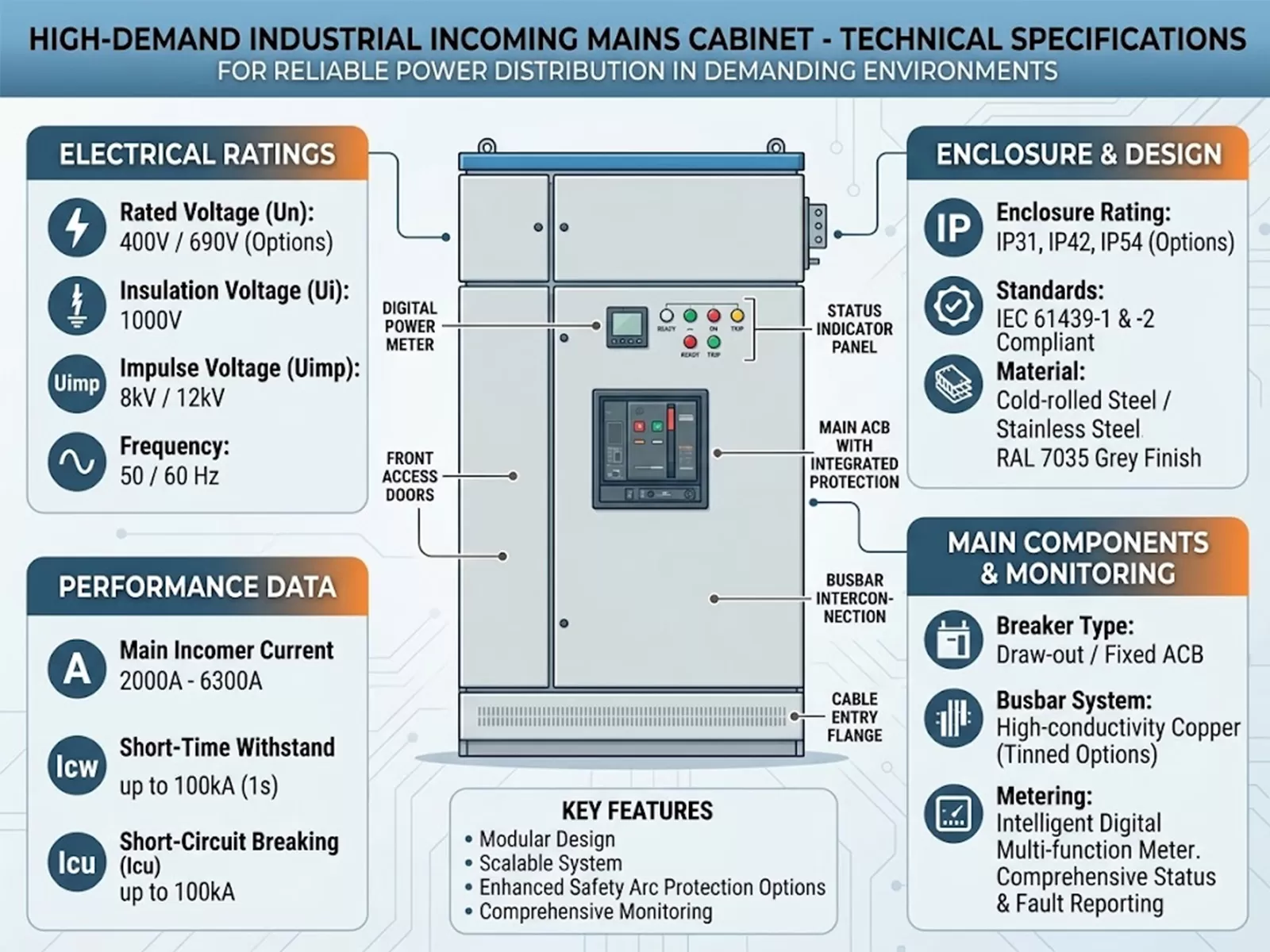
Key Factors to Consider When Selecting an Incoming Mains Cabinet
Specifying heavy-duty equipment requires evaluating both electrical thresholds and physical site constraints. Facility managers must balance immediate power demand with future capacity expansions.
.webp?t=1784778325333 "How to Choose an Incoming Mains Cabinet (2)")
1. Electrical Capacity and Short-Circuit Protection
Heavy industrial loads create extreme electrical stress during motor startups and continuous peak operations. Your incoming unit must clear severe grid faults without destroying internal switchgear.
○ Select an heavy-duty air circuit breaker panel with draw-out capability for seamless servicing and high fault protection.
○ Verify the short circuit withstand capacity matches or exceeds your local grid transformer fault current ratings.
○ Calculate total continuous current requirements, including a minimum 20% growth margin for future facility machinery.
2. Environmental Protection and Thermal Management
Harsh indoor or outdoor operating conditions drastically affect the lifespan of internal breakers and copper components. Ambient heat, moisture, and dust accelerate electrical insulation breakdown over time.
○ Choose an IP31 enclosure for clean indoor electrical rooms or IP54/IP65 for dusty, high-humidity manufacturing plants.
○ Specify forced-air cooling fans with replaceable dust filters to dissipate heavy thermal accumulation during peak hours.
○ Ensure the industrial electrical enclosure uses anti-corrosion powder coating to withstand aggressive industrial air.
Application Scenario vs. Recommended Specifications Matrix
| Application Scenario | Recommended IP Rating | Breaker & Busbar Specs | Additional Critical Features |
| Heavy Steel Mill / Foundry | IP54 / IP65 | Draw-out ACB (4000A+), 100kA Busbar | Forced ventilation, dust filters, thermal monitoring |
| Indoor Factory / Warehouse | IP31 / IP42 | Fixed or Draw-out ACB (1600A-3200A), 65kA | Compact footprint, digital power quality meter |
| Outdoor Utility Drop Site | IP65 (NEMA 4X) | Heavy-duty ACB with SS316 Enclosure | Rain canopy, anti-condensation heaters, UV coating |
3. Footprint, Cable Entry, and Clearance Constraints
Electrical room dimensions heavily dictate how your incoming lineup connects to upstream utility feeds. Restricted maintenance access risks non-compliance with international electrical safety codes.
○ Confirm top vs bottom cable entry requirements to eliminate awkward bending radiuses for massive copper feeds.
○ Ensure a solid, high-conductivity copper busbar system is used instead of aluminum for high-ampere applications.
○ Maintain minimum front and rear clearance space to allow technicians to safely draw out main breakers.
4. International Standards and Compliance
Adhering to global switchgear standards guarantees total safety during utility grid synchronization. Non-compliant equipment faces severe customs delays and rejected site acceptance tests.
○ Verify full compliance with IEC 61439-2 or UL 891 standards for low-voltage power switchgear.
○ Request certified type-test reports covering temperature rise, dielectric strength, and short-circuit withstand capabilities.
○ Ensure all internal low voltage switchgear components carry recognized CE, UL, or ISO quality marks.
.webp?t=1784778325333 "How to Choose an Incoming Mains Cabinet (3)")
Customization vs. Standard Configurations
Standard off-the-shelf cabinets offer lower upfront costs but rarely accommodate complex factory power feeds. Custom-engineered switchgear ensures exact alignment with your facility layout.
○ Custom busbar routing allows direct connection to transformer duct flanges without expensive field modifications.
○ Tailored instrument compartments house modern power meters, smart surge arresters, and remote monitoring gateways.
○ Pre-wired control terminals simplify integration with plant-wide SCADA and energy management systems.
.webp?t=1784778325333 "How to Choose an Incoming Mains Cabinet (4)")
Evaluating the Total Cost of Ownership (TCO)
Smart procurement managers look far beyond the initial purchase price of the metal box. Long-term energy losses, thermal degradation, and emergency downtime dominate total equipment lifetime costs.
.webp?t=1784778325333 "How to Choose an Incoming Mains Cabinet (5)")
○ High-purity copper busbars reduce internal electrical resistance and cut long-term operational heat losses.
○ Draw-out breaker designs reduce scheduled maintenance downtime from hours to mere minutes.
○ Robust enclosure sealing prevents dust contamination, dramatically extending component service life.
Supplier Selection Criteria: Beyond the Product
Partnering with a capable OEM switchgear manufacturer guarantees smooth project execution from design to commissioning. Your vendor must offer comprehensive engineering support rather than just basic metal fabrication.
○ Evaluate their in-house CAD capabilities to quickly translate your single line diagram into production-ready 3D models.
○ Verify their factory testing facilities for temperature rise, high-voltage withstand, and mechanical endurance tests.
○ Ensure they provide complete shipping protection and export packaging for heavy industrial switchgear.
Vendor Evaluation Checklist Matrix
| Evaluation Criteria | Red Flag (Avoid Vendor) | Green Flag (Premium OEM Supplier) | Business Impact |
| Engineering Support | Only offers stock metal boxes; no CAD/SLD review | Full 3D CAD modeling and custom busbar engineering | Eliminates expensive on-site rework |
| Quality Testing | No in-house testing reports provided | Provides full IEC/UL type-test certificates | Guarantees compliance and safety |
| Component Sourcing | Uses unbranded, unknown electrical breakers | Uses top-tier global or verified OEM breakers | Extends operational lifespan |
| Delivery & Assembly | Ships flat-pack loose pieces for site assembly | Ships fully assembled, pre-wired, and factory-tested | Reduces field installation labor |
FAQ
Q1: What is the main difference between an incoming cabinet and an outgoing feeder cabinet?
An incoming cabinet receives primary bulk power directly from the utility transformer and houses the master system breaker. An outgoing feeder cabinet sits downstream, splitting that power into smaller branch circuits for machinery.
Q2: Why is a draw-out breaker design preferred for an incoming mains panel?
Draw-out breakers allow maintenance teams to rack out the breaker for inspection without disconnecting heavy busbars. This drastically improves technician safety and cuts plant downtime during emergency servicing.
Q3: How do I size the copper busbar rating for an incoming mains panel?
Busbar sizing depends on peak continuous current, ambient operating temperature, and maximum fault levels. Always add a 20% to 25% safety margin above full load transformer rating to handle future facility expansion.
Q4: Can an incoming mains panel be installed outdoors?
Yes, provided it is built inside an IP54 or IP65 outdoor-rated weatherproof enclosure with a rain canopy. Outdoor units should also include anti-condensation heaters and UV-resistant powder coatings.
.webp?t=1784778325333 "How to Choose an Incoming Mains Cabinet(6)")
Secure Your Plant with Fully Integrated Switchgear
Building a reliable power distribution infrastructure requires precision engineering and proven factory manufacturing.
As a premier manufacturer of heavy-duty low-voltage switchgear, we deliver fully assembled, custom-tailored incoming cabinets built for continuous factory operation. Send our engineering team your Single Line Diagram (SLD) today for a rapid, customized technical proposal.





.webp?t=1787649054185 "22-Day Delivery: 50kW Sync Panels to Philippines")
.webp?t=1787648147488 "Xdepe 100% FAT Protocol Ensures Zero-Defect Electrical Cabinets")
.webp?t=1787647313485 "Top 10 Power Distribution Cabinet Manufacturers")
.webp?t=1787642349973 "Xdepe HV & LV Electrical Cabinets Achieve Full CE Certification")
.webp?t=1787641839853 "Top 10 Floor-Standing Electrical Cabinet Manufacturers")