
Introduction
Relying on a single massive generator for a large facility is incredibly risky. If that main unit fails or requires maintenance, your entire factory faces a total blackout.
Running a large generator at low loads during off-peak hours also wastes immense amounts of fuel. Engineers solve these efficiency and reliability issues by linking multiple smaller generators together.
This is precisely where a professional generator synchronization panel becomes the most critical asset in your power plant. It acts as the brain, commanding multiple power sources to act as one unified grid.
.webp?t=1790749587970 "Generator Synchronization Panel1 (1)")
What is a Generator Paralleling Switchboard?
A generator paralleling switchboard is a highly specialized electrical cabinet that connects two or more generators to a common electrical bus.
It ensures that all connected generators match their electrical output perfectly before merging their power. Once synchronized, the system automatically distributes the facility's demand evenly across all active engines.
Here are the core functions of this complete assembled system:
● Automatic Synchronization: Matches the voltage, frequency, and phase angle of incoming generators to the main busbar.
● Active Load Sharing: Prevents one engine from being overloaded while another runs idle.
● Automatic Starting and Stopping: Turns on additional generators when plant power demand spikes.
● Dead Bus Synchronization: Safely starts the first generator to power up an entirely dead facility grid.
Standard Technical Specifications for Synchronization Panels
| Parameter | Standard Range / Option | Engineering Note |
| System Capacity | 50kW up to Multi-Megawatt | Configurable from a compact 50kW generator synchronization panel to massive grid systems. |
| Operating Voltage | 400V / 415V / 480V | Matches standard global low voltage grids. |
| Main Busbar Material | High-Purity Tinned Copper | Ensures massive current handling without overheating. |
| Protection Rating | IP42 (Indoor) / IP54+ (Outdoor) | Sealed against harsh industrial dust and moisture. |
How Does DG Synchronization Work?
Understanding the operation of a DG synchronization panel involves basic electrical physics. Connecting two active power sources that are out of phase will result in catastrophic short circuits and engine damage.
The synchronization process follows a strict, automated sequence:
● Step 1 (Monitoring): The panel's internal controllers constantly monitor the live busbar's existing voltage and frequency.
● Step 2 (Regulating): The controller sends signals to the incoming generator's engine governor to adjust speed (frequency).
● Step 3 (Matching): It simultaneously adjusts the alternator's automatic voltage regulator (AVR) to match the bus voltage.
● Step 4 (Closing): Once phase angles align perfectly for a set duration, the motorized breaker snaps closed.
.webp?t=1790749587970 "Generator Synchronization Panel1 (2)")
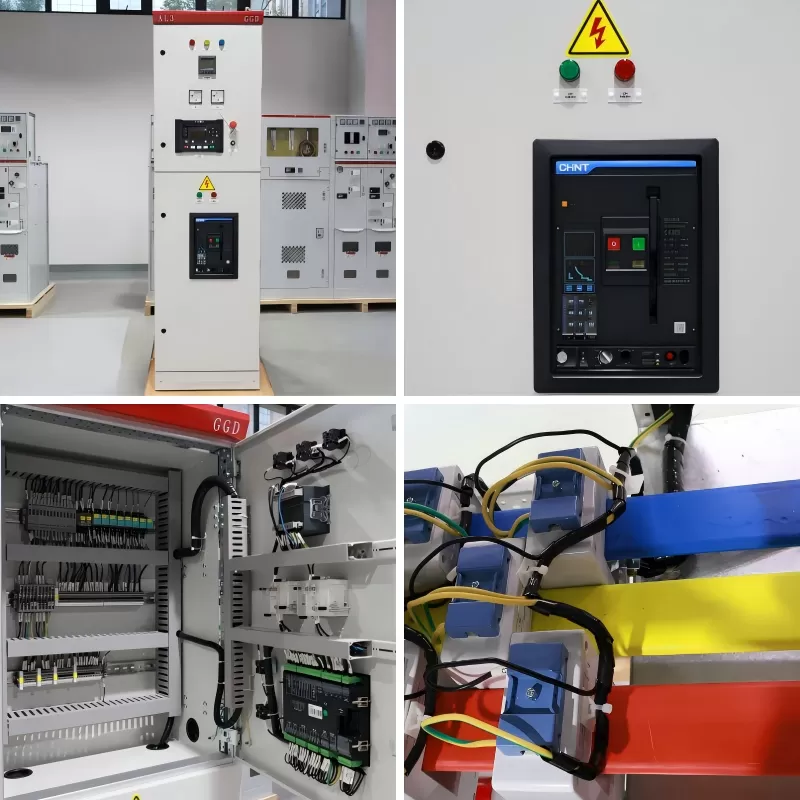
Key Components Inside the Cabinet
A reliable paralleling switchgear system is only as good as its internal hardware. These cabinets contain advanced logic controllers combined with heavy-duty power switching components.
1. Master Synchronization Controllers
These microprocessor-based modules are the central brain of the operation. They execute the complex math required for phase matching in milliseconds.
2. Motorized Circuit Breakers (ACBs/MCCBs)
Standard breakers require manual operation. Synchronization panels use heavy-duty motorized breakers that can close instantly upon receiving the controller's digital command.
3. Load Sharing Modules
A dedicated load sharing panel relies on these modules to divide the active (kW) and reactive (kVAR) loads proportionally. This guarantees stable engine temperatures across all running generators.
4. Synchroscope (Visual Indicator)
While the system is fully automatic, a synchroscope is usually mounted on the front door. It gives operators a visual rotating dial to verify phase alignment during manual override procedures.
Main Types of Paralleling Systems
Not every power plant requires the same layout. Engineers usually select between two primary architectural designs based on site safety requirements.
Linear Paralleling Systems
○ This is the standard configuration for most industrial factories and commercial buildings.
○ All generators connect to a single, straight main busbar inside the low voltage distribution cabinet.
○ It offers a highly cost-effective and straightforward installation footprint.
Ring Paralleling Switchgear
○ Designed for mission-critical facilities that cannot tolerate a single point of failure on the busbar.
○ The power bus is designed in a closed loop, often split by tie-breakers.
○ If a fault occurs in one section of the switchgear, power easily routes the other way around the ring.
Island Mode vs. Utility Parallel Mode
| Operation Mode | Grid Connection Status | Primary Application |
| Island Mode Paralleling | Completely isolated from the main utility grid. | Remote mining sites, offshore platforms, or full emergency backups. |
| Utility Parallel (Grid-Tied) | Generators run simultaneously with the utility grid. | Peak shaving, selling power back to the grid, or soft-transfer transitions. |
Typical Applications and Industries
Any facility where continuous power is a matter of safety or extreme financial impact requires these systems. A high-end power management panel provides the ultimate electrical insurance policy.
● Hospital and Healthcare: Guarantees zero-interruption power to critical life support and surgical operating theaters.
● Hyper-Scale Data Centers: Ensures server racks remain online during utility transitions without dropping a single data packet.
● Remote Oil & Gas Fields: Manages multiple diesel generators to power massive drilling rigs in off-grid desert or marine environments.
● Heavy Manufacturing: Provides enough burst power to start massive hydraulic motors without tripping the plant grid.
.webp?t=1790749587970 "Generator Synchronization Panel1 (3)")
FAQ
Q: Can I parallel generators of different sizes or brands?
A: Yes. Modern generator control panels can easily synchronize units of different sizes (e.g., a 500kW and a 1000kW unit). The intelligent load-sharing modules will demand power proportionally from each engine based on its maximum capacity.
Q: What happens if the synchronization controller fails?
A: Premium complete assembled systems always include a manual bypass. Skilled operators can use the physical synchroscope and manual breaker controls to parallel the units safely during an emergency.
Q: Do I need a separate transfer switch with a paralleling panel?
A: It depends on your facility's design. Many advanced synchronization panels have integrated main utility breakers, acting as a complete auto mains failure and power management system in one unified enclosure.
Q: How does this system save on fuel costs?
A: Instead of running a 2000kW generator at 20% load at night (which is highly inefficient and harms the engine), the panel shuts it down and seamlessly transfers the light load to a smaller 500kW unit, operating it at peak fuel efficiency.



 Cabinet (1).webp "Automatic Transfer Switch (ATS) Failure: 5 Common Causes and How to Fix Them")
.webp "How to Select the Right 3 Phase Panel Board for Heavy Manufacturing Equipment")
 Switchgear (1).webp "What is a Withdrawable (Drawer-Type) Switchgear? A Complete Beginner's Guide")
.webp "Main Distribution Board vs. Sub Main Distribution Board: What's the Difference & How to Choose?")
